Idiopathic scoliosis can begin in infancy, childhood or adolescence, and curve progression is possible whenever substantial growth remains. However, Adolescent Idiopathic Scoliosis (AIS) is the most common type of scoliosis, accounting for 80% of all scoliosis cases. Research studies however do indicate 'hereditary' is a contributing factor.
'Idiopathic' means there is no single identifiable cause that has been that has been proven to date. Scientific evidence points to there being multiple predisposing factors and growth-related tiggers which cause idiopathic scoliosis.
Visible Symptoms of Adolescent Idiopathic Scoliosis
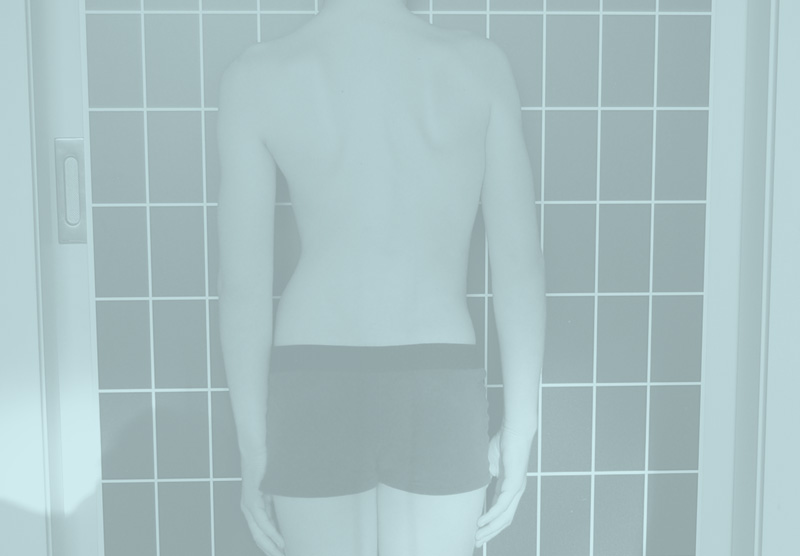
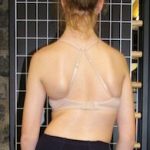
The two images displayed below show patients whose pattern of idiopathic scoliosis is a single right thoracic curve and a prominent and elevated left hip, the most common AIS curve pattern.
-

- (1)
-
- (2)
Thoracic curves display the following noticeable characteristics:
- Shoulder asymmetry.
- Waist asymmetry.
- Rib prominence on forward bending.
- Visible trunk shift.
- Shoulder height difference.
- Shoulder blade prominence.
- Rib hump visible even while standing.
- Prominent Hip
- Pelvic imbalance in larger curves.
For a comprehensive explanation of the visible symptoms (clinical characteristics) of idiopathic scoliosis, go to: Common Types of Idiopathic Scoliosis and Prominent Hips - Idiopathic Scolios And to understand how curve progression evolves and it's impact on an individual go to: Schroth Scoliosis Rehabilitation.
Understand Risk of Curve Progression during Adolescent Growth Spurt
Curve progression is possible whenever substantial growth remains.
The earlier the onset of idiopathic scoliosis the greater the risk of progression which is primarily related to curve magnitude and growth potential (Lonstein & Carlson). For example a child with a thoracic curve (the most common AIS pattern) has a higher progression risk if their curve is greater than 30° before the peak growth phase of their adolescent growth spurt.
In girls, peak growth occurs on average 6 to 12 months before Menarche (first menstrual period), though there are exceptions. After Menarche maximum growth has usually passed (Dimeglo 2001). However, significant spinal growth nevertheless remains, but progression risk decreases, until it eventually stops at skeletal maturity. In general, for girls this is usually age 14 and for boys age 16.
The main risk factors of curve progression based on documented scientific research and summarised by the SOSORT 2016 Guidelines are:
- Curve magnitude (Cobb angle)
- Skeletal maturity - remaining growth
- Sex (females are at greater progression risk)
- Curve pattern (as an additional, lesser factor)
Treatment for Adolescent Idiopathic Scoliosis
Treatment of Adolescent idiopathic scoliosis patients as defined by the Scoliosis Research Society (SRS), falls into 3 categories: Observation-Bracing-Spinal Fusion Surgery.
Observation is the most widely used treatment for curves below 20°. Bracing if a patient's curve is diagnosed as progressive which, is usually at around 25°. If bracing is not successful, and a patient's curve continues to progress to >40º, spinal fusion surgery may be prescribed.
Today, for parents who have a child with AIS, there are other treatment options available: Schroth physiotherapeutic scoliosis-specific exercise treatment (PSSE); and 3D Chêneau style asymmetrical bracing.
Schroth Method Patient-Parent Treatment Programs & 3D Cheneau Style Asymmetrical Bracing
In all cases of adolescent idiopathic scoliosis, especially where there is a high risk of curve progression, timely assessment and consideration of appropriate treatment are important. The key aim is limiting the risk of curve progression and reducing the likelihood of progression to surgery.
Our conservative Schroth Method Patient-Parent Treatment Programs provide young patients and their parents with customised physiotherapeutic scoliosis-specific exercise (PSSE) treatment.
Our 6 day program treatment goals help young patients:
- understand their individual scoliosis
- Develop three-dimensional postural self-correction
- improve postural awareness and control
- Improve movement and function
- Learn exercises specific to their curve pattern
- Apply their corrections during daily activities
- Develop the skills to actively participate in managing their scoliosis
Schroth PSSE treatment and 3D Chêneau Style Asymmetrical Bracing, which take into account the three dimensional (3D) nature of the condition and the risk of progression, can be effective in limiting curve progression in childhood and adolescence.
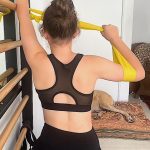
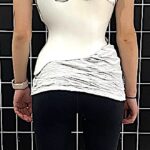
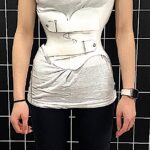
Images (3) and (4) below show a patient performing a thoracic correction and a lumbar and thoracic correction respectively. Images (5) and (6) show a patient fitted with a 3D Chêneau style asymmetrical custom designed brace to correct her single right thoracic curve and left prominent hip.
-
- (3)
-

- (4)
-
- (5)
-
- (6)
What If Bracing Is Not An Option
Often adolescents are not diagnosed with idiopathic scoliosis until after they have experienced their rapid adolescent growth spurt. While they have not yet reached skeletal, their growth has slowed down as has the progression risk. In such cases the effectiveness of bracing declines due to their being little growth remaining. Sanders et al. (JBJS, 2008)
For such individuals, some of whom may have already experienced unsuccessful bracing, brace treatment is no longer considered a treatment option for preventing curve progression.
Rather than take no action, our six-day PSSE, concentrated one-to-one Schroth Method Patient-Parent Program may provide an additional conservative treatment option, an opportunity to actively treat and manage scoliosis rather than simply waiting for the next stage of the condition. Your child would learn how to use their body differently—and develop skills they can continue to use throughout life. Importantly, you would be present helping your child.
Our program provides sufficient time for detailed assessment, education, repeated practice, refinement of three-dimensional corrections and development of an individualised home program.
Schroth Method Patient-Parent Program
Our Schroth Method 6 day PSSE Program is customised for individual patients based on their primary curve type.
To learn more, you can Download a summary of the content, structure and scope of our program:
- Juvenile & Adolescent Idiopathic Scoliosis(opens in new tab)
If you have any questions about our program's suitability for your child:
And to enquire about our program costs: