3D Chêneau Style Asymmetrical Bracing
Idiopathic scoliosis is recognized as a three-dimensional (3D) disorder affecting the spine and trunk in 3 planes:
The Frontal plane, a lateral movement; the Transverse plane; spinal torsion; and the Sagittal plane, Abnormal changes to spinal kyphosis and lordosis.
Scoliosis progression is primarily related to curve magnitude and growth potential.
Without treatment, curves 25–50° will likely progress and curves >50° will progress after skeletal maturity.
Scientific evidence now shows that timely intervention of appropriate 3D Chêneau Style Asymmetrical Bracing during periods of rapid growth in childhood can prevent curve progression, even reduce Curves, and Improve trunk deformity.
This is particularly so in adolescence, when peak growth occurs at the beginning of puberty.
A Bracing Perspective
In 2014 Dr Weiss, an orthpaedic specialist, published a case report of a bracing case in which his patient achieved a persistent long term clinical and radiological correction.
He conducted the case based on (1) the premise that bracing is the primary treatment for scoliosis patients during their growth spurt, (2) his concerns about the various standards and efficacy of brace treatment patients worldwide receive, and (3) significantly whether bracing could effectively result in a persistent long term positive corrective outcome.
His case involved a girl aged 11 with a 38° single thoracic curve which was considered, without treatment, to be at a very high risk of progression. She required a second brace before being weaned off the treatment at 15 having reached skeletal maturity.
6 years after brace treatment, when she was almost 21, her thoracic curve had stabliszed at 19° - 50% less than her curve at 11 years of age. She had full functionality and was extremely satisfied with the outcome.
In his case report Dr Weiss concluded:
- Bracing scoliosis maybe highly efficient and is supported by scientific evidence
- Bracing according to the cutting-edge developments has been shown to be able to improve the angle of curvature as well as the trunk deformity.
- Bracing according to the cutting-edge developments appear able to lead to relevant and lasting improvements of the Cobb angle and trunk deformity in the long term.
Scientific research has shown that there are a wide variety of braces available to patients but many lack evidence of effectiveness. Whatever the brace, for it to be effective, it needs to provide persistent long term positive corrective outcomes.
What are the key attributes of effective Bracing
- Rigid, but made of lightweight, moldable polyethylene for comfort
- CAD/CAM custom designed to a patient's unique curve pattern
- Asymmetric design for true 3D correction
- Pressure points and openings at spinal cavities to induce correction and reduce rotation
- Voids (openings) to allow for Schroth corrective breathing and ribcage expansion
- Open hip design for enhanced mobility and pelvic correction
- Doesn't crush the chest or cause breast distortion during growth
- User friendly front closing straps to allow patient independence


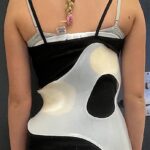
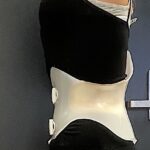
In the top row the brace shown is correcting a severe primary right thoracic curve and a secondary left lumbar curve. In the bottom row the brace is correcting a moderate left lumbar curve and a right prominent hip.
Scoliosis Therapy Centre's Bracing Partners
Grace Addison
InMotion Orthotics
The Scoliosis Therapy Centre collaborates closely with InMotion Orthotics & the Victoria Sports and Rehabilitation Clinic in providing optimum outcomes for juvenile and adolescent idiopathic scoliosis patients.
Our collective goals is for our patient is to limit further curve progression, if possible reduce their curve(s) and and provide them with a long term positive corrective outcome.
InMotion Orthotics is located in Southport, Qld:
Contact: Grace Addison
Victoria Sports and Rehabilitation Clinic is located in Mt Eliza, Vic
Contact: Dr Danial Comerford
Click on the following citation to access the case report and study briefly explained on this page:
Weiss HR. Bracing can lead to a persistent correction in the treatment of Adolescent Idiopathic Scoliosis: A case report. Hard Tissue 2014 Apr 18;3(1):8.
Schroth exercises can Improve Bracing outcomes
There is also scientific evidence to show that Schroth exercises performed by patients with a high risk of curve progression during bracing can improve the bracing outcome when compared with bracing alone.
Kwan KYH, Cheng ACS, Koh HY, Chiu AYY, Cheung KMC. Effectiveness of Schroth exercises during bracing in adolescent idiopathic scoliosis: results from a preliminary study—SOSORT Award 2017 Winner. Scoliosis and Spinal Disorders. 2017;12:32. doi:10.1186/s13013-017-0139-6.
Schroth Method
Treatment for Scoliosis
(To view all images on this page
and sidebar in an enlarged
slideshow just click on an image
at random.)