
Right Thoracic Curve & Prominent Left Hip
Patients (1) and (2) displayed below have a primary right Thoracic curve categorized as severe and very severe respectively. In each case their Thoracic curve is compensated by a left Prominent Hip, which is also elevated and higher than the right. Despite the fact both patients weight bear through their right leg, the side of the Thoracic curve, neither have a physical leg length discrepancy.
-

- (1)
-
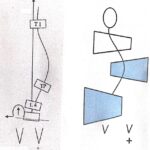
- Body Statics – Body Blocks
-
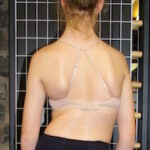
- (2)
Left Lumbar Curve & Prominent Right Hip
Patients (3) and (4) below have a primary left Lumbar curve compensated by a right Prominent Hip. Patient (4) also has a secondary right Thoracic curve. In both cases the right Prominent Hip is elevated and both patients weight bear through their left leg. Yet again, neither patient has a physical leg length discrepancy.
-

- (3)
-
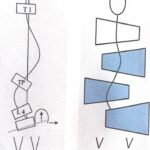
- Body Statics – Body Blocks
-
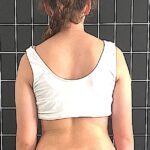
- (4)
Body Static - Body Blocks
The schematic diagrams Body Statics - Body Blocks, centred above, highlight the impact of Idiopathic Scoliosis from a posterior view for both major Thoracic and Lumbar curve types.
Body Statics show the junction of the thoracic and lumbar spine - the Thoracolumbar Transition (TP) which is extremely significant. Which side of the spine's central midline it's located, determines the primary curve.
The sideways shift of the pelvis is highlighted by the resultant Prominent Hip, which is also elevated. The + sign indicates the weight bearing which in the majority of cases is on the same side as the primary curve.
Wedge shaped Body Blocks highlight the sideways (lateral) movement of the segments of the spine and the lateral shift of the pelvis away from the body's midline.
Functional Vs Structural Scoliosis
Idiopathic Scoliosis is a structural disorder for which there is currently no known specific cause. So, It's important then to distinguish between Idiopathic Scoliosis and Functional Scoliosis.
The International Scientific Society on Scoliosis Orthopaedic and Rehabilitation Treatment (SOSORT) 2016 Guidelines explain the difference between Idiopathic Scoliosis and Functional Scoliosis (refer to page 3).
In the case of a Functional Scoliosis there is a physical leg length discrepancy. A Podiatrist's heel lift in the shoe of the shorter leg can temporarily remedy the discrepancy on a daily basis. However once the heel lift is removed, the Functional Scoliosis remains.
From a Podiatry perspective the following website:
https://northernriverspodiatry.com.au/conditions/leg-length-discrepancy/
(randomly selected) describes how a trained Podiatrist manages a leg length discrepancy:
"By adding blocks underneath one foot incrementally, a trained podiatrist can monitor at which stage the hips become level. This method has its limitations though. While it serves the function of confirming where there is a leg length discrepancy present, it alone cannot determine the cause of the difference."
In summary, Idiopathic Scoliosis is a Three-Dimensional (3D) disorder. Curves move sideways (laterally), backwards (posteriorly), and rotate (transversely) inwards. In primary Thoracic and lumbar curve types, Prominent Hips compensate for these Structural curves, but do not cause a physical leg length discrepancy.
Schroth Method
Treatment for Scoliosis
(To view all images on this page
and sidebar in an enlarged
slideshow just click on an image
at random.)